1) What is a Continuity? What is a Discontinuity?
A Continuity is a graph that can be drawn without having to lift your pencil off the paper, meaning that the graph will have no holes, jumps, or breaks within the line. While a discontinuity is a graph that will have breaks, holes, and/or jumps within the graph.
Continuity Graph:

Discontinuity Graph:
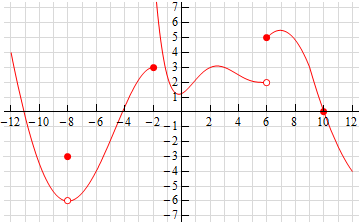
2) What is a limit? When does a limit exist? When does a limit not exist? What is the difference between a limit and a value?
A limit is the intended height of a function, it exists when the line on the graph from the left or right meets up in the same place.and the same value of x and has no discontinuity whatsoever. Limits exist only when there are discontinuities, the difference between a limit and a value is that the value is an exact answer while the limit is just a notation explaining the discontinuity on the graph.
Example of Values:

Example of a Limit:

3) How do we evaluate limits numerically, graphically, and algebraically?
We can evaluate a limit numerically by making a chart which represents our x-values F(x). We then write our limit statement: lim-->x f(x)=x while subbing the x when necessary. We can evaluate the limit graphically by looking at the graph to check and see if there are any points of discontinuity, if there are no points of discontinuity then the graph will have no limits. We can solve a limit algebraically by substituting x from our limit statement to our functions. There are a total of 4 different answers that we can receive from doing this: A number, 0, undefined (DNE), and 0/0 which means that it cannot be found there. This means that you will have to multiply the conjugate to get rid of the 0 in the denominator and simplify, then start from there again.


