Tuesday, June 4, 2013

Unit V BIG Question

1. Unit V “Big Questions” Blog Post - Explain in detail where the formula for the difference quotient
comes from now that you know!  Include all appropriate terminology (secant line, tangent line, h/delta x, etc).  Your post must include text and some form of media (picture/video) to support your writing.

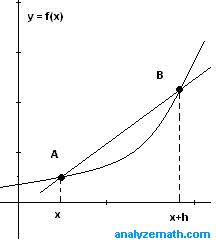
The Difference Quotient can be explained as we are attempting to find the tangent line in a function on a graph. First we will have a curved line that has a secant line that will touch the graph twice and a tangent line that will only touch it once. At the farthest point of intersection, we will use dx to solve for the secant line and labeling it as h. As we see that the secant line is no where near the tangent line, the equation is f(x+dx)-f(x)/dx. We need to find the value for the secant line that is closer to the tangent line. We can make dx smaller so that the secant line is barely touching the tangent line. The slope of the secant line can be described as the difference quotient, we can find the slope by using the slope formula which is m=y2-y1/x2-x1. Then we can plug in the x-value (x+h) and then the y-value (f(x+h)) the new equation would be (f(x+h)-f(x))/(x+h)-x)). As we simplify this function we see that f(x+h)-f(x) does not simplify. Then we use lim-->0 to show that the secant line and the tangent line cannot touch.
Here is an example of how the difference quotient turns out to be, A being the tangent and B the secant:
This video explains the Difference Quotient:


Links used: 
http://www.analyzemath.com/calculus/Differentiation/difference_quotient_1.gif
http://www.youtube.com/watch?v=XA0fZh8cXV8


Tuesday, May 28, 2013

Unit U Big Questions

Unit U Big Questions
1) What is a Continuity? What is a Discontinuity?

A Continuity is a graph that can be drawn without having to lift your pencil off the paper, meaning that the graph will have no holes, jumps, or breaks within the line. While a discontinuity is a graph that will have breaks, holes, and/or jumps within the graph.
Continuity Graph:

Discontinuity Graph: 


2) What is a limit? When does a limit exist? When does a limit not exist? What is the difference between a limit and a value?

A limit is the intended height of a function, it exists when the line on the graph from the left or right meets up in the same place.and the same value of x and has no discontinuity whatsoever. Limits exist only when there are discontinuities, the difference between a limit and a value is that the value is an exact answer while the limit is just a notation explaining the discontinuity on the graph.
Example of Values:
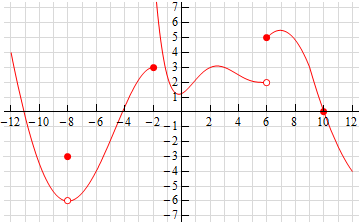
Example of a Limit:


3) How do we evaluate limits numerically, graphically, and algebraically?

We can evaluate a limit numerically by making a chart which represents our x-values F(x). We then write our limit statement: lim-->x f(x)=x while subbing the x when necessary. We can evaluate the limit graphically by looking at the graph to check and see if there are any points of discontinuity, if there are no points of discontinuity then the graph will have no limits. We can solve a limit algebraically by substituting x from our limit statement to our functions. There are a total of 4 different answers that we can receive from doing this: A number, 0, undefined (DNE), and 0/0 which means that it cannot be found there. This means that you will have to multiply the conjugate to get rid of the 0 in the denominator and simplify, then start from there again.

Wednesday, March 20, 2013

Blog Post 3

3. Write four of your own Concept 4 problems (one from each level) and solve them. Explain each step.

Blog Post 1

1. Show and explain how to derive the two remaining Pythagorean identities from sin^2(x)+cos^2(x)=1. Make sure to include in the beginning where sin^2(x)+cos^2(x)=1 comes from to begin with (think Unit Circle!).

The reason is that sin^2 + cos^2 = 1 is written differently from cotangent and tangent. So dividing the first equation by sine^2 or cos^2, they will then cancel out. This will then leave you with an answer related to your ratio identities and your reciprocal ratios which as you know will be: 1/cos^2(x) is the same as sec^2(x), 1/sin^2(x) is the same as csc^2(x).